COVER- Boar war: Pig slaughter raises questions
Published October 5, 2006 in issue 0540 of the HooK. By LISA PROVENCE LISA@READTHEHOOK.COM 
As the 12 shotgun blasts rang out from the special pen that Cindi Henshaw reserved for her favorite pets, she sat in her living room and realized, "They just shot Cupid and Valentine." Three weeks later, tears still well up when she tells about the pair of Russian boars she raised from infancy and that followed her around like dogs. Cupid and Valentine were in their pen September 14 when government agents shot them, wrapped chains around their 500-pound bodies and dragged them off, leaving behind a trail of blood. Cindi's husband, Danny Henshaw, a former police officer who'd done undercover narcotics work, is a former nationally ranked bow-hunter who made hunting videos for a decade. The last thing he expected was to be arrested in a SWAT-style raid on his Buckingham County hunting preserve and to see his herd of Russian boars slaughtered by shotgun-toting state and federal officials. The government calls it "depopulation," an effort to stop a potentially deadly livestock disease. But to the Henshaws and some independent farmers, what happened was a horror, an overreaction, and-- with nearly 80 hogs taken by 12-gauge shotguns-- overkill. And now the U.S. Department of Agriculture is investigating whether its own procedures were followed in the depopulation.
Early awakening Cindi and Danny Henshaw normally awaken at 5:30 every weekday so she can teach a Bible class for teenagers. But on Tuesday, September 12, they were awakened early, around 5am, by a game warden who had come to arrest Danny for operating a wild boar hunting enclosure without a permit. Once he was in custody, the predawn raid continued: nine SUVs filled with USDA agents pulled onto the Henshaws' 153-acre farm in remote Buckingham County, says Cindi, put the farm under quarantine, and for the next 11 days, blasted away at the feral pigs. By her count, the death toll reached 79. The reason? Pseudorabies. The Henshaws had never heard of pseudorabies and weren't aware their hogs had been tested for the disease. Not to be confused with rabies, pseudorabies-- also known as Aujesky's Disease and "mad itch"-- is a highly contagious swine infection caused by a herpes virus. Virginia is pseudorabies-free and intends to stay that way. But what if an infection is found? "Our standard procedure is to depopulate the herd," says Virginia Department of Agriculture and Consumer Services spokeswoman Elaine Lidholm. And the Henshaw hogs had pseudorabies, she says, along with another swine disease, brucellosis.
Not a secret Cindi and Danny consider themselves law-abiding citizens. "I was married to a judge," says Cindi, on a tour with a news crew three weeks after the incident. Also the owner of a construction company, she says, "I don't want people to think we're these mud-pit people." Danny now finds his facility under quarantine, and he's facing a Class 2 misdemeanor that carries up to a $1,000 fine. "They could have sent me a summons," he notes. The preserve was no secret. Danny had run Willis River Hunting since 1990, and although they moved the facility about six years ago, the website, willisriver.com (promising "hog hunting at its best") identifies its location as western Buckingham County. The place is also advertised in Woods and Waters magazine. "This is not something you need a password to get in," says Cindi. "I'm so irritated because he's done this for 16 years." The Virginia General Assembly outlawed mammalian shooting enclosures in 1998, but Danny says he called the commonwealth's attorney in Cumberland, where his preserve was then located, for guidance at that time. Henshaw says he was told that private reserves were not subject to the regulation, so Willis River became a private club. What some USDA agents now dub "the compound," Danny Henshaw considers a labor of love where he dug every post hole for fencing to enclose the approximately 100-acre preserve. Members pay $50 to hunt-- $450 if they shoot a boar. The still shell-shocked Henshaws say they can't understand what they consider heavy-handed tactics that included a 24-hour guard around the preserve during the 11-day government presence. What is the appropriate level of force? "It would depend entirely on the circumstances," says the state's Lidholm, listing factors such as the legality of the shooting enclosure, the attitude of the owner, and whether it's a repeat offense. Henshaw says he's never had a run-in with authorities over his preserve. The same day Danny Henshaw was arrested, the state descended upon the hunting preserve of Eugene Davis at 5am in adjacent Cumberland County. Davis says authorities found pseudorabies in his breeding facility in 2002 and bought the animals, but they didn't shut him down because breeding the animals is not against the law. He, too, was charged with an illegal shooting enclosure as well as illegal transport. "By the authority vested in the state veterinarian, we believe [Willis River] fits the definition of a shooting enclosure, which is illegal in Virginia," Lidholm says. "[Henshaw] had this operation in another area when it was legal," says Captain Ron Henry with the Virginia Department of Game and Inland Fisheries, which was called in to provide security and a 24-guard over the preserve. "He moved it and didn't get a permit." Henry contends that Henshaw lost his "grandfathering" when he moved from Cumberland to Buckingham. "I heard how we stomped in and threatened these people," says Henry. "That was not the case." Actually, the Henshaws have nothing but praise for the game wardens. But they have a different opinion of the USDA agents who slaughtered their herd. "The USDA guys wouldn't talk to me," complains Cindi. "We hadn't gotten test results, and they were killing our animals. No one would tell me anything. I was sitting in my house not knowing what the hell was going on, and I was trying to understand what we had done wrong."
Government-only The Henshaws are astounded that they were not allowed to take blood samples from their own hogs before the animals were hauled away for incineration. Cindi says an attorney told her that of the 79 killed, 42 were tested, and 15 came back positive for pseudorabies. "I don't believe it," she says. "I don't believe anything that came out of that lab." Under certain-- but not necessarily all-- circumstances, says the state's Lidholm, owners might be allowed to take their own samples. "I can see how we'd suspect that was a delaying procedure," she says. "A person would have a hard time challenging our labs." According to the state's quarantine and kill orders, the sample that alerted the Virginia Department of Agriculture came from a hunter-- who was also a state agent-- who shot a boar at Willis River and had the meat tested. The blood can be collected prior to death or shortly after death, says Lidholm. Cindi Henshaw contends they have no way of knowing how soon the samples were taken after death and whether they were even from their hogs. And, she says, the tests have a high false-positive rate. The fact that simultaneous raids occurred in Buckingham and Cumberland raises plenty of eyebrows. Eugene Davis says the pigs in his breeding facility tested negative, and if that's the case, in a couple of weeks they won't be destroyed. But at his separate hunting preserve, agents went in shooting and destroyed 26 animals. According to the warrant, says Davis, a hunter tested an animal killed April 1 that came up positive. "Why did they wait five months and 11 days to come if they want to be pseudorabies free?" wonders Davis. "There are no checks and balances," says Danny Henshaw, who mentions that when he was a cop and arrested people for DUIs, the suspects could have a sample to do their own testing. "You can't just have the government do the testing," he says. The Henshaws also wonder why, if pseudorabies is so contagious, pools of blood were left all over their property, and the dead animals were hauled off in regular stock trailers. "We are looking into possible violations of our procedures in transport of animals from a pseudorabies area to a nonpseudorabies area," says USDA spokesman Jim Rogers. The handling of the case has provoked outrage among independent farmers in Virginia-- and beyond. "If what I have been told took place," says Amherst farmer Dick Stevens, "I just can't believe our state and federal government would handle a disease situation as they did. I would think you would show some testing proof." When Oklahoma farmer Sue Karber heard about the Henshaws, she drove to Virginia to see for herself. "[Danny] had no representation on this whatsoever," says Karber. "There's no way of knowing if the animals tested are theirs. We've had too many cases when the whole herd were killed that weren't diseased." "It's real similar to what my relatives told me about the old days in Germany," Karber says in a phone interview. "I don't want them to knock on my door."
Mad sheep? When she heard the news about the Henshaw pig killing, one woman felt a sad sense of déjà vu. "My first reaction was to burst into tears," says Linda Faillace. She knows how it feels to lose animals. She and her husband spent three years working with USDA officials to import sheep to their Vermont farm from Belgium, New Zealand, and the Netherlands. They had a dream of creating artisanal cheeses from exotic sheep, and when the dream ended, it ended, ironically, with the USDA leading the charge. According to Faillace's memoir, Mad Sheep, released last month, the feds suspected mad cow disease. The armed raid took place on March 23, 2001, at the family farm near Warren, Vermont. Federal agents put the entire 125-head herd on a flatbed truck and shipped them to Ames, Iowa, for testing, but by the time the tests proved that no sheep had mad cow disease, the animals the Faillace family worked so hard to import had been destroyed-- killed, they believe, to render moot their emergency lawsuit alleging "arbitrary and capricious" government action. USDA spokesman Rogers, who was there, disputes that allegation. "They would have been put down anyway," he says. And, he adds, the sheep tested positive for TSE-- transmissible spongiform encephalophacy, though the agency can't say that the strain was mad cow. Five years later, the quarantine on the Faillace's Three Shepherds farm has just been lifted, but their dreams of raising sheep are destroyed. They now run a store and make cheese from purchased milk. "No sheep in the world has ever had mad cow disease," says Linda Faillace. "They've studied it for 21 years now." Ironically, she and her husband knew a few things about the disease before they began importing sheep. Larry Faillace earned his Ph.D. in animal physiology at Virginia Tech and did post-doctoral work at the University of Nottingham in England under mad cow researcher Eric Lamming. Linda Faillace was Lamming's lab technician and assistant. Larry Faillace believes he understands the USDA's motivation. "It's because they represent agri-business," he says. "There's a revolving door between Monsanto and the USDA, and they view the [local] food movement as a threat." However, veterinary researcher Kevin Pelzer doesn't see it that way. Pelzer, of Virginia Tech's large animal clinical sciences faculty, says pseudorabies was a serious problem until the USDA launched a massive eradication effort (spending over $72 million) in 1989. "That's been going on for quite a while," says Pelzer, "but it was only recently that domesticated herds in the states were certified free of the disease." Virginia got its certification in 1996; the last four states got their clean slate on pseudorabies in 2003. "It's one of those diseases we need to be aware of to contain it," says Pelzer, "and keep it from spreading to commercial producers of swine." Nearly all young piglets who get the disease succumb. Pelzer points out that while adult pigs usually survive a bout with pseudorabies, their reproductive system may not. That puts the profits of farms at risk. But what happens to other animals is more dire. Sheep, cattle, cats, and even man's best friend, dogs, can catch the disease-- which is spread through the respiratory system and which runs its course in just two to five days, Pelzer says. The result is nearly always death. The Henshaws maintain that none of their hogs exhibited symptoms of pseudorabies-- certainly not sterility. After the first raid ended on September 22, a number of piglets-- the Henshaws declined to guess how many-- were still roaming the preserve. Federal agents returned on Tuesday, October 3 to take them out.
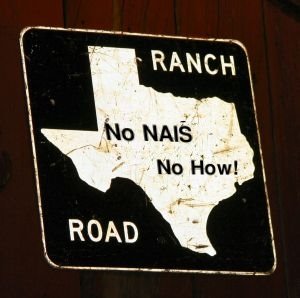
Overcrowded family farm? In a USDA document availalable for download, an official rams home a point about a major pseudorabies transmission factor in all-capital letters: "OVERSTOCKING PENS." To many family farms, the mere idea of overstocked pens seems a touchstone for the divide between their mission and that of big agri-business. Amherst farmer Dick Stevens says he is shocked by "unethical farming practices" allowed by the government. He agrees with researchers who contend that mad cow disease was caused by government-approved "cannibalism"-- permitting waste cow parts to enter the feed of a naturally vegetarian, cud-chewing animal. "We're going against Mother Nature here," he says. Stevens is part of a group called the Virginia Independent Consumer and Farmer Association, a group that opposes another government plan: to identify every animal in the country with an ear tag or an embedded computer chip. NAIS, the National Animal Identification System, is also bitterly opposed by Walter Jeffries, a farmer in West Topsham,Vermont. While he says his real blog is the one about his own family farm, Jeffries started an anti-NAIS blog in January, and he has made the "Henshaw Incident" big news on nonais.org. Jeffries worries that the simultaneous raids in Buckingham and Cumberland are just an opening salvo in a larger war on independent farmers. "They're really used to using fear as a weapon," he says. "People are very scared."
Preserves under fire The raid at Willis River has raised a controversy besides the discussion of disease and property rights: the propriety of hunting preserves. Such places have created dust-ups before. Albemarle House, the sumptuous Keene-area estate inhabited by Patricia Kluge, once got some unwanted attention when wildlife officials found that employees were killing protected birds-- including hawks and owls-- that were picking off pheasants and other exotic game birds being farmed for English-style field hunts. In 1988, three Kluge employees were found guilty of unlawful kills, and the hunting preserve was disbanded. Ten years later, Virginia outlawed confined hunting areas. "These are horrible, disgusting places," says Stephanie Boyles, a wildlife biologist with People for the Ethical Treatment of Animals. She calls "morally reprehensible" the "canned hunt facilities," such as the preserve where Vice President Dick Cheney accidentally shot a fellow hunter in the face earlier this year. "They should never have been allowed to occur in the United States, and we need to put an end to it," she says. Still, she doesn't like the sound of what happened to the Henshaws' wild boars. "They're obviously going to be terrified," she says. "That was a cruel and traumatic way for them to die. The federal officials should have handled that in a more compassionate way." But for avid hunter and part-time taxidermist Danny Waters of Millboro, Willis River Hunting bears no resemblance to shooting fish in a barrel. "I don't believe in a canned hunt," says Waters, who says the 100-plus acres of Willis River give the hogs a fighting chance. "There's people that deer hunt who don't hunt on that much land." Waters, who has recommended Willis River to several friends, says the hogs get smarter as they get older and that the dense underbrush that cloaks the preserve gives the animals a fighting chance. "It's a challenging hunt," says Waters. "It ain't no day in the park."
Heavy-handed tactics? "I'm 64 years old, and I've never opposed my government before," says Dick Stevens. But when news of the Henshaw incident reached him, Stevens says, "I realized what it was all about and the underhanded methods the USDA seemed to be using." Stevens worries that controversy over the propriety of hunting preserves will blur the issues. "I'm a hunter, and I can't imagine myself using one of those [preserves], but that's not the point," he says. "If they can use these methods on a hunting preserve club, what will keep them from going onto property of a small farmer and eliminating those animals?" As they take visitors on a tour of the preserve, Danny and Cindi Henshaw point out the trash and bloodstains left by the government operation, and mercifully don't point out the human waste left by the agents. "You smell that?" asks Danny, referring to a dead pig left to rot out of sight in the woods. Cindi, too, laments what she brands asa lack of compassion by the agents, such as a "hog down" cartoon on the back of a vehicle, or the high-fiving of four-wheeling agents as they killed another one of their animals. And of course, Cupid and Valentine. Cindi says that she bottle-fed the pair, raised them as pets, and often showed them off to visiting 4-H Club students. She doesn't understand why a contented, penned pair of pets had to be part of the slaughter. "This seems to be the USDA's tactic to just go in very heavy-handed," says the former Vermont sheep farmer, Linda Faillace. "Why are they going in and treating farmers as criminals?" When her farm was raided five years ago, Fallaice says, "They showed up with 27 armed federal agents, 13 USDA officials-- 40 people to get 125 sheep who would all line up in a row if you had a feed bucket." Cindi and Danny Henshaw are Mormons, and she decries the waste of the meat, which could have been eaten because pseudorabies is not transmissible to humans. Mormons also believe in storing a reserve of food. "These hogs," she says, "were part of our food supply." The couple's faith in the government has been severely shaken. "I will never, ever look at a government official in the same way again," Cindi says. --with additional reporting by Hawes Spencer and Courteney Stuart 
Danny Henshaw and his wife, Cindi, who considered herself a "city girl who didn't know how to pee in the woods" before she married hunting ace Danny. Now the Mormon couple says they're ready to "go Ruby Ridge" over their treatment by federal and state agricultural agents.
PHOTO BY WILL WALKER

The Willis River Hunting website promises an "exciting" hunt of feral Russian boars.
FROM THE WILLIS RIVER WEBSITE

USDA agents left this trap to lure the shoats who escaped the initial 11-day eradication effort in the Willis River preserve, which, in the midst of Westvaco territory, had been clear-cut.
PHOTO BY WILL WALKER

Danny Henshaw comforts Cindi at the pen where Cupid and Valentine, their pet pigs, where shot.
PHOTO BY WILL WALKER

The Henshaws survey their 153-acre farm in the far southwest corner of Buckingham.
PHOTO BY WILL WALKER

Danny Henshaw was a top-ranked bow hunter, appeared on TV's Wild and True hunting show, and produced hunting videos. He
PHOTO BY WILL WALKER

A wild boar, also known as a razorback.
PHOTO BY BONITA CHESHIER
# |